

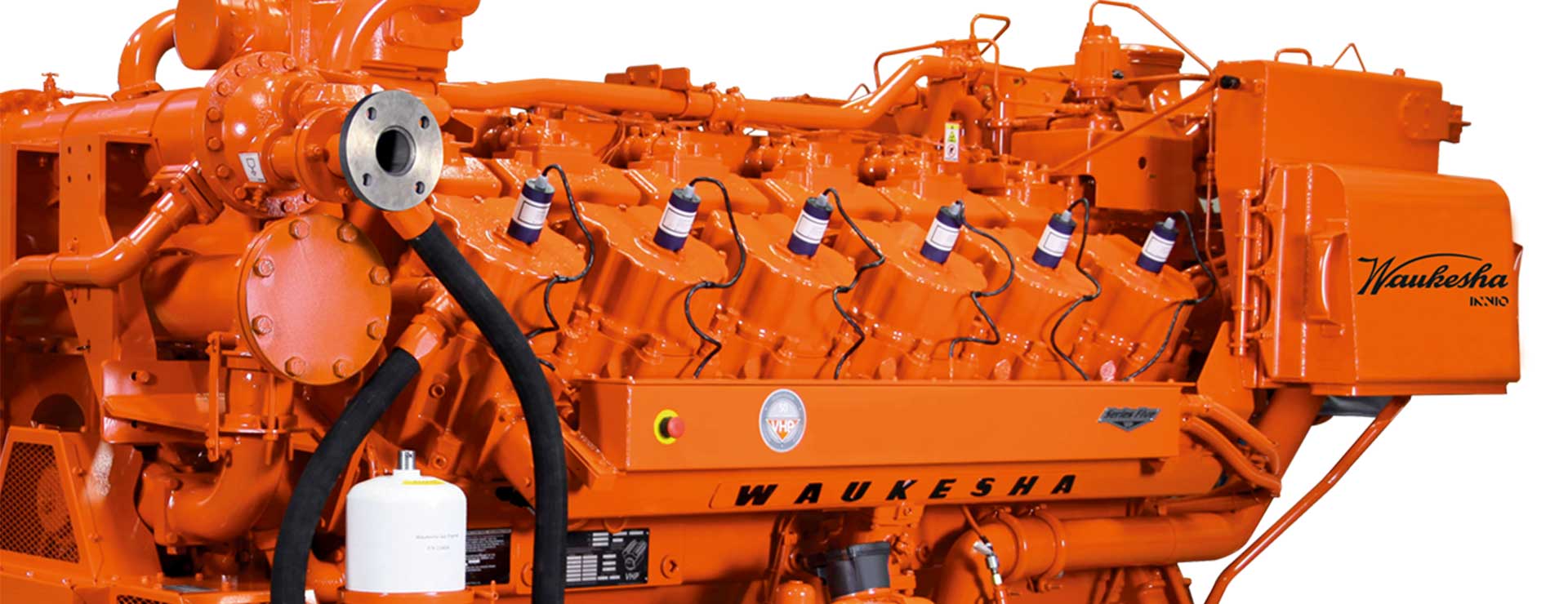
ETS-Astana has initiated the utilization of INNIO’s Waukesha Series 5 engines.
Since the onset of 2023, ETS-Astana LLP has extended its line of serial containerized gas reciprocating power plants to include a new model. The newly introduced gas reciprocating power plant, now in mass production, has a nominal power of 1250 kW, representing a significant 15% increase compared to its closest predecessor.
The latest addition to our product line utilizes Waukesha gas genset from the new 5 Series, renowned for its increased power output. Meanwhile, the engine dimensions remained unchanged compared to the previous version. It might be assumed that the engine began operating in a more intense mode, resulting in increased load on its individual components. However, this is not the case. On the contrary, the engine became less loaded. This was achieved through several factors: firstly, the adoption of enriched fuel mixture burning technology based on the Miller cycle; secondly, modifications to the cylinder head design to decrease temperatures in critical zones; and thirdly, optimization of the piston design.
These technical innovations have significantly impacted the operational characteristics of the gas reciprocating power plant:
Increased fuel versatility
The new gas reciprocating power plant can operate stably on complex gases. The engine operates at full power even with gas compositions rated WKI* 55 and higher. The engine’s lifespan remains largely unaffected even in the presence of sulfur-containing components in the fuel gas, up to 0.2% molar fraction.
Capability to operate effectively in environments characterized by high ambient temperatures and at high altitudes
The GRPP can maintain its power output even in hot regions at high altitudes above sea level. ЭTC-W1560 can operate without derating within specified limits: ambient temperatures up to +40°C and altitudes up to 1000 meters above sea level. Even at altitudes exceeding 1000 meters and under higher temperatures, the new GRPP remains operational, albeit with a slight reduction in output power.
Decreased operating costs
Despite the increased power compared to its predecessor, the operational costs of the new gas reciprocating power plant have decreased by 22%. Achieving such results was made possible thanks to the following factors:
- Utilizing less expensive spark plugs with an increased lifespan. Employing base metal spark plugs and a new generation ignition power module (IPMD2) extends the spark plug replacement interval to 4000 hours;
- Extended oil change intervals. The improved piston design has extended oil change intervals to 4000 operating hours. The need for replacement depends on the gas composition and operating conditions and is determined by the actual condition;
- Reduced number of service team visits for engine maintenance, resulting in lower operating costs.
Increased intervals for major maintenance
One notable advantage of employing the Miller cycle in the combustion process is the decrease in temperature at the end of the compression stroke. While a lower temperature might suggest a longer service interval, the designers didn’t stop there. New cylinder heads were specially developed with XCOOLED cooling technology, featuring optimized coolant flow. This innovation further reduces the temperature at individual points of the valve group by 10 to 40%. Furthermore, the gas engine employs a piston design with a reduced piston crater volume, resulting in a temperature reduction of up to 50°C in the upper ridge of the piston. These design enhancements have significantly increased the service life of the cylinder head, now ranging from 24,000 to 30,000 hours.
It’s worth noting that the Miller cycle requires more intense boosting than a traditional engine running on a rich fuel mixture. To achieve such a boost, the engine utilizes a new powerful turbocharger, constructed with materials exhibiting higher strength characteristics compared to the previous containerized GRPP. This enhancement allows for an increased service life ranging from 24,000 to 30,000 hours.
Ease of management and troubleshooting
Similar to its predecessor, the novel GRPP employs the new generation ESM2 motor controller, featuring a sizable resistive touch screen. Interaction with the controller is versatile, including touch input from fingers, gloves, or styluses, as the screen is responsive to pressure from any object. Previously, accessing precise settings or diagnostics required the use of a separate laptop or computer. Now the touch screen allows full interaction with all systems. The new controller functions are highlighted below:
- Full-color display of engine operating parameters graphically represented;
- Display of all faults, along with a built-in step-by-step troubleshooting module;
- Control of exhaust and main bearing temperatures, as well as oil pressure;
- Misfire control.
Furthermore, ESM2 offers integration capabilities with myPlant platform.
